





By Elle Williams, CPDT-KA
Pet Columnist, Canyon Lake Insider
“My dog is stubborn,” is something every dog trainer is told tens, if not hundreds, of times throughout their career. It must be a really common canine trait to be stubborn. Or is it?
I’m not here to dismiss how anyone feels about their dog but rather look at it from a dog’s point of view.
Let’s address how the misdiagnosing of stubbornness does nothing to help address your dog’s problems. If anything, it places the blame on the dog without considering any of the more likely reasons a dog may put on the brakes and ignore what we ask.
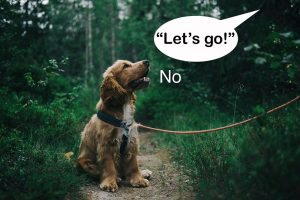
Let’s look at the most detrimental use of the label. A person’s dog won’t perform a physical act such as “they are stubborn on walks, and often stop to protest” or “my dog is too stubborn to go in the car.” If we label it as a clear choice to deliberately disobey us, we miss that stopping or not performing a physical activity could be a sign of pain since dogs don’t usually show signs of pain until the pain is extreme. Owners might miss the signs that could have led to helping treat pain if they view their dog’s behavior as stubborn.
Let’s say it’s not pain-related. A dog hesitating or resisting could be that it’s having a hard time overcoming a fear. Look for signs that your dog is stressed, anxious, or fearful by reading its body language when it suddenly refuses to do something. Do you notice a tucked tail? Maybe it’s licking its lips and nose a lot. Are they turning to look in different directions periodically? Are they panting when it’s not hot? Maybe its head is low, its eyes wide, and its forehead creased. Does it seem on edge? Maybe that sudden stop was its way of saying, “I can’t go further, it’s too scary.”
Besides fear and physical pain, stubbornness is often labeled when a dog is simply fulfilling a need like stopping to sniff something rather than coming back to you when called. That smell could be more important to its instinctual needs, such as finding a mate or avoiding danger. There’s a good chance it’s weighing the value of what it’s doing compared to what you are asking it to do or, even more realistic, it’s focused on its needs and might not be mentally able to focus on you at the same time.
Another common reason to not comply is if what you asked of the dog was linked to a previously averse outcome. For example, the last time you asked it to come to you was to give it ear drops. If it struggles with ear drop applications, the next time it hears “come,” it will associate that with the unpleasant sensation of getting ear drops put in, even if that’s not the situation you’re currently asking it to come for. So ask yourself, when was the last time you asked it to do the behavior and what was the outcome? Was it pleasant or unpleasant?
Does your dog understand what you are asking of it? You might think it knows a behavior but has it been taught that behavior in many places, or has it been taught that behavior among distractions? Dogs are pretty bad at generalizing and simply teaching a dog behaviors in one place doesn’t mean it will understand how to do that behavior in multiple environments.
To break it down, here’s what to ask yourself when you feel your dog is being stubborn:
- Could it be because of pain?
- Could I make it easier for my dog to understand what I’m asking?
- Does my dog know how to do what I’m asking?
- Is what I’m asking more rewarding than what my dog is doing? And if not, how can I make it more rewarding?
- Is what I’m asking my dog to do something that led to an unpleasant outcome in the past?
Dogs do what works for them, not out of spite or stubbornness. When we break things down into simple and positive steps, dogs are pretty good at understanding what we want of them. If you’re having trouble with your “stubborn” dog, seek a qualified dog trainer/behaviorist to help you find the root cause for the lack of response.
Elle Williams is a local in-home dog trainer and the owner of Give a Sit Dog Training. She is certified in dog psychology, nutrition, and grooming, and specializes in basic and advanced obedience, puppy prep, and behavior adjustment training.